Unified360 monitors network, servers, databases, virtualisation, applications and links from one console, with auto-discovered topology, business-service views, alerting with escalation and automation with guardrails. It runs as a containerised stack on your own servers, including air-gapped sites.
See the business impactFollow a failing component up to the application your users depend on, instead of chasing separate alerts.
One console, fewer toolsNetwork, servers, databases, applications, links and URLs in a single platform.
Fixes without the waitApproved scripts run when an alert fires, so common problems are handled without waiting on a person.
Know your networkTopology is discovered and drawn for you, and configuration drift raises an alert.
Your data stays yoursRuns on your own servers, including air-gapped sites through an offline installer.
Ready for many customers or sitesCustomer-scoped data and roles, with proxy servers reporting from remote sites.
Key capabilities
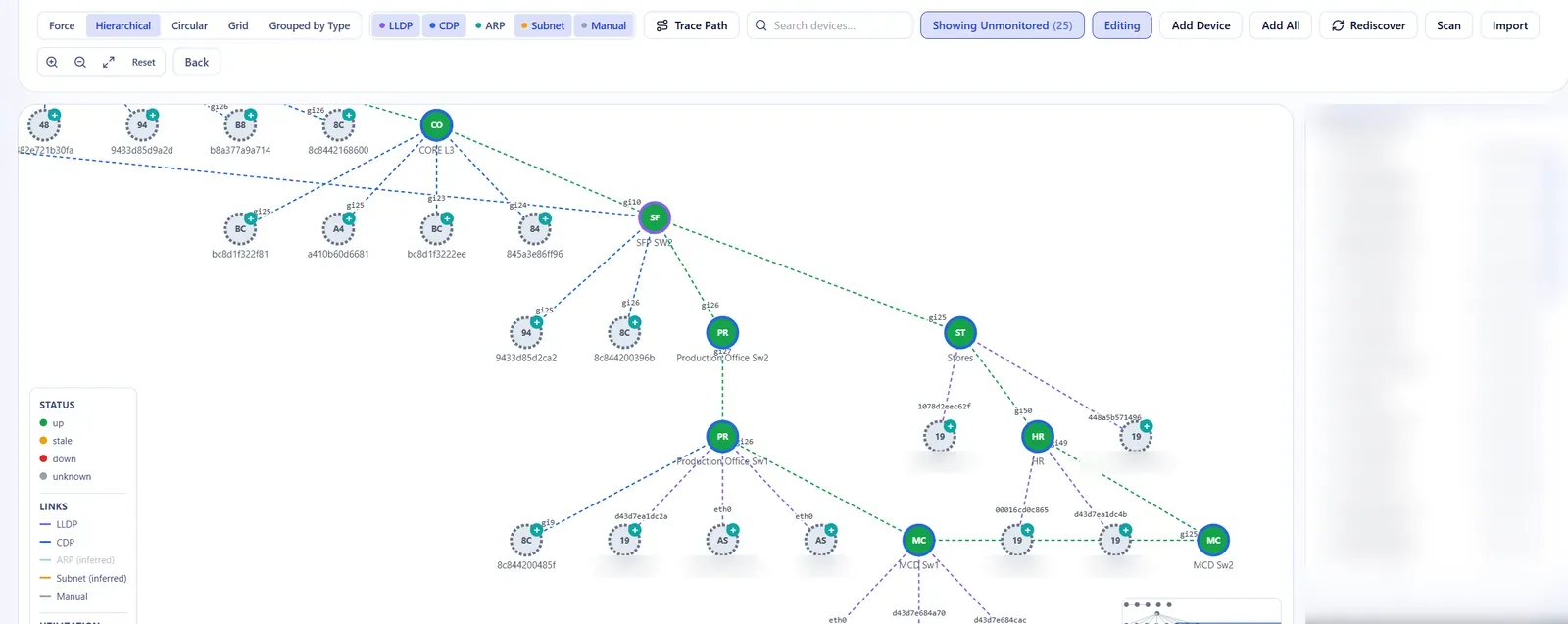
Network TopologyAuto-discovered, interactive maps built from LLDP, CDP, ARP and subnet data, with manual links, filtering by discovery source and live status on every device.
Link UtilizationISP, ILL and MPLS links tracked for availability, latency, jitter, packet loss and in/out bandwidth utilization, with custom time ranges.
Business Service ManagementModel business applications as services bound to the monitors beneath them, and follow impact from a failing component up to the application.
IP Address ManagementSubnets, IP allocation and utilization, scheduled discovery, conflict and stale-IP detection, switch-port mapping and exportable reports.
Network MonitoringSNMP polling with vendor templates, interface and bandwidth tracking and device up/down detection across switches, firewalls and controllers.
Server and Desktop MonitoringLightweight agents report CPU, memory, disk, network, services and file changes for Windows and Linux endpoints.
Database MonitoringAvailability and performance for SQL Server, Oracle, PostgreSQL and MySQL with threshold-based alerts.
Virtualization and HardwareProxmox, Nutanix and vCenter, plus out-of-band hardware health through Dell iDRAC and HP iLO.
Application and SyntheticIIS, Tomcat and JBoss monitoring alongside URL, port and ping checks.
Alerting and EscalationRule-based alerts with recovery tracking, escalation policies and a central Alarm Console with full event history.
Automation and RemediationAutomation rules, a script library, credential vault and run history so common fixes happen without waiting on a person.
Config Backup and DriftScheduled device configuration backups, kept snapshots, and alerts when a configuration drifts.
Dashboards and ReportsServer, application, database, desktop, network, link and synthetic overviews, plus availability and performance reports.
Multi-Customer and LicensingCustomer-scoped data, roles and permissions, license management and remote proxy servers for distributed sites.
Key differentiators
One console across the whole stackNetwork, servers, databases, applications, URLs, wireless and links, with topology built from LLDP, CDP, ARP and subnet data.
Business services, not just devicesBusiness Service Management shows which application is impacted and which monitor beneath it is failing.
Automation with guardrailsApproved scripts run on an alert. Versions are checksummed, approval by a different person is the default, destructive runs wait for a human and a cooldown stops flapping alerts.
Config backup and drift includedScheduled backups, kept snapshots and drift alerts are part of the platform.
Multi-customer from the ground upEvery target, rule and report belongs to a customer, and scoped users see only their own.
Air-gapped readyAn offline installer for Ubuntu 24.04 and RHEL 9 for networks with no internet access.
Deployment architecture
The whole stack runs as containers on your own servers. A lightweight mode can skip the metrics components.
Deployment, security and integration
Runs on your serversA containerised stack on your own infrastructure, including air-gapped sites through an offline installer. Offline bundles are provided for Ubuntu 24.04 and RHEL 9.
Secure by designRole-based permissions, customer scoping enforced on the server, LDAP authentication and multi-factor login. Credentials are stored encrypted and never returned by the API.
Distributed sitesProxy servers and agents collect data close to the source and report back to one console.
Built to integrateMetrics are stored in a dedicated time-series store, alerting runs as a standalone service, and every module is backed by a JSON API.
System requirements
Hardware (minimum)
4 CPU cores, 8 GB RAM, 50 GB disk (SSD recommended)
Operating system
Ubuntu 24.04 LTS, or RHEL 9 / CentOS 9 / Rocky Linux 9
Software
Docker Engine and Docker Compose v2. The installer installs Docker if it is missing.
Offline installation
Bundles for Ubuntu 24.04 and RHEL 9 for environments with no internet access
Agents
Windows and Linux endpoints
Access
A current web browser
Licensing model
Unified360 is licensed with a signed licence file for your organisation, with a start date, an expiry date and a grace period.
The file enables the modules you buy: monitoring, service management, privileged access, automation and configuration backup.
It also sets limits on the total number of monitored objects and on users.
 PRODUCT DATASHEET